
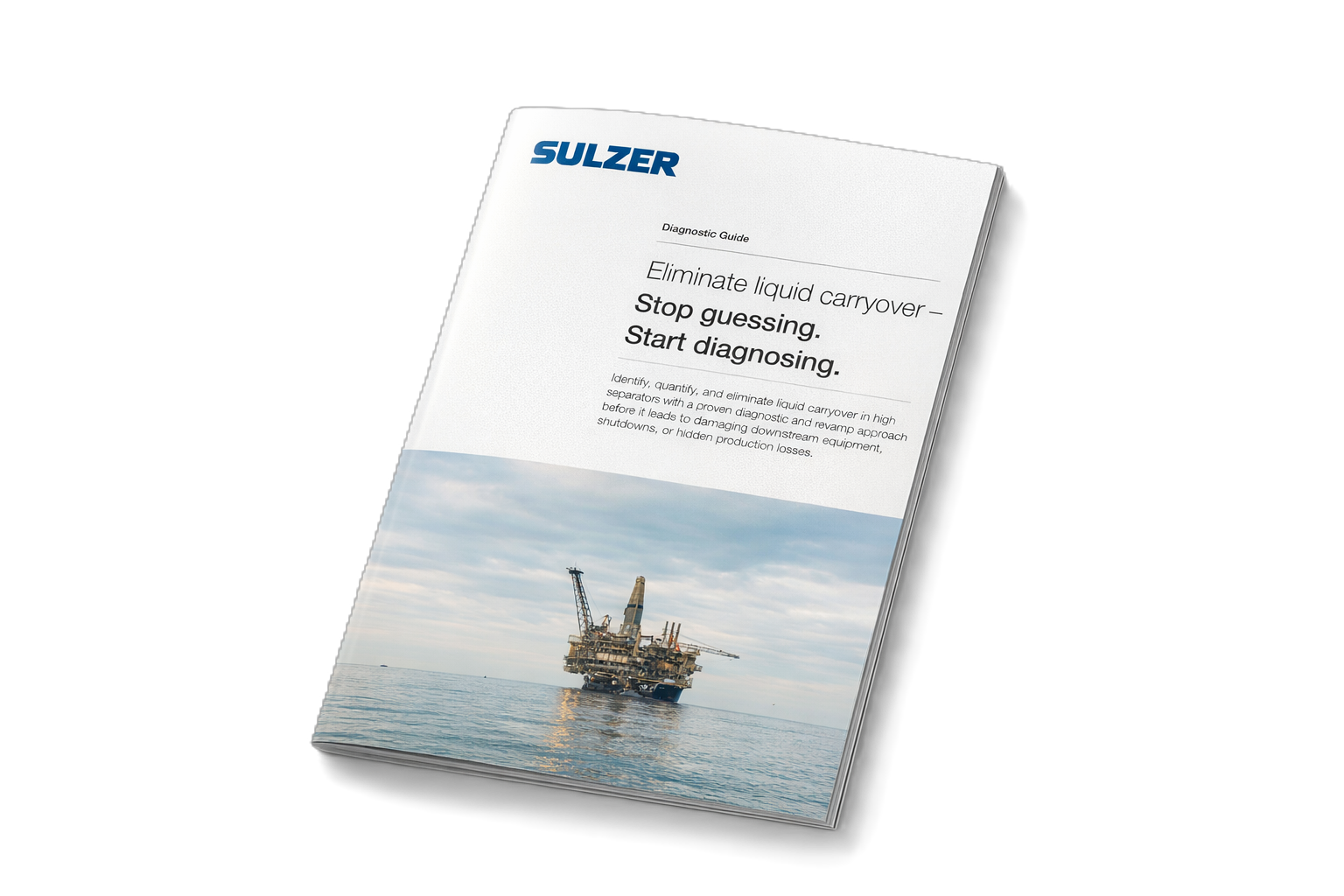
Free diagnostic guide 

Stop guessing.
Start diagnosing.

Identify, quantify, and eliminate liquid carryover in high-pressure separators – before it damages downstream equipment, causes unplanned shutdowns, or silently erodes your production. 

<0.1
US gal/MMscf carryover after revamp
68 bar
Operating pressure in case study
3 min
To complete the risk diagnostic

Liquid carryover is costing you – even when you do not see it 

Carryover rarely announces itself as a single failure. It silently erodes margins through compressor damage, unplanned maintenance, and downstream degradation – often for months before anyone connects the dots. 

 
Unplanned shutdowns
Liquid ingress into compressors or gas treatment units causes mechanical damage and forces costly interventions at the worst possible times.
 
Constant scrubber draining
Downstream scrubbers drained every few hours are not a process quirk — they are a symptom of upstream separation failure that compounds over time.
 
Corrosion and blockages
Entrained liquids accelerate corrosion, promote hydrate formation, and create pipeline blockages that threaten safety and long-term asset integrity.
 
Hidden production losses
When carryover goes undiagnosed, production losses accumulate invisibly — eroding margins without triggering the alarms that prompt investigation.
 
High-pressure blind spots
At elevated pressures, gas density narrows the separation margin significantly. Internals designed for moderate pressure simply do not perform the same way.
 
The guesswork cycle
Without a structured diagnostic approach, teams swap internals and hope. Upgrading a single component rarely solves the underlying system-level issue.

Everything you need to move from symptoms to solutions

The diagnostic guide is built around Sulzer's proven separation principles in high-pressure service. It gives process and operations engineers a structured, practical framework.

01
Carryover risk diagnostic checklist
Complete the 3-minute self-assessment to place your separator in a low, moderate, or high-risk category, and know what to do next.
02
Why conventional internals fail 
Understand why wire mesh eliminators and vane packs underperform at elevated pressures, and what conditions accelerate the failure.
03
System-level revamp approach
Learn the five-stage separation strategy – from inlet conditioning to high-efficiency cyclonic separation – and why single-component upgrades rarely solve the problem. 
04
Real-world Middle East case study
A 68 bar slug catcher revamp with verified third-party results: from scrubber draining every 13 hours to guaranteed separation performance.
05
CFD-based diagnosis explained
Discover how Computational Fluid Dynamics (CFD) reveals maldistribution and bypass zones that field measurements alone cannot detect.
06
Early indicators to watch for
Recognize the operational signs that point to carryover before they escalate, so you can act on evidence, not assumptions.

From daily problems to stable operation

From daily problems
to stable operation

A major upstream facility operating three identical high-pressure slug catchers at 68 bar absolute was experiencing persistent liquid carryover – verified by downstream scrubber measurements – despite existing wire mesh mist eliminators. 

The solution was not a component swap. It was a system-level approach, validated with CFD and installed without vessel modification. 
Results
 
Liquid carryover reduced to
<0.1 US gal/MMscf
Validated by independent third-party measurement
 
Scrubber draining frequency
Every ~13 hours → once per month
After full implementation
 
Installation method
No vessel shell modification
Non-welded internals – no post-welding heat treatment (PWHT) required
 
Outcome
Guaranteed separation performance
New benchmark set for similar high-pressure revamp projects
Free download

Get the diagnostic guide now

  3-minute carryover risk self-assessment
  System-level revamp framework
  Verified Middle East case study
  CFD diagnosis explained
  No sales call required
Gas processing diagnostic guide image