Silos to Systems: Smarter Separation for Chemical Industries
Combine evaporation, distillation, absorption, liquid‑liquid extraction and crystallization in a holistic design to cut costs and emissions. Download the white paper to learn how.
Proven ROI
CAPEX reduction up to 30%
OPEX reduction up to to 40%
Payback between 2 to 4 years
Flexible solutions
Adapt to variable feedstocks and specs. Handle many separation processes in one design.
Sustainable results
Energy integration
CO2 reduction up to 50%
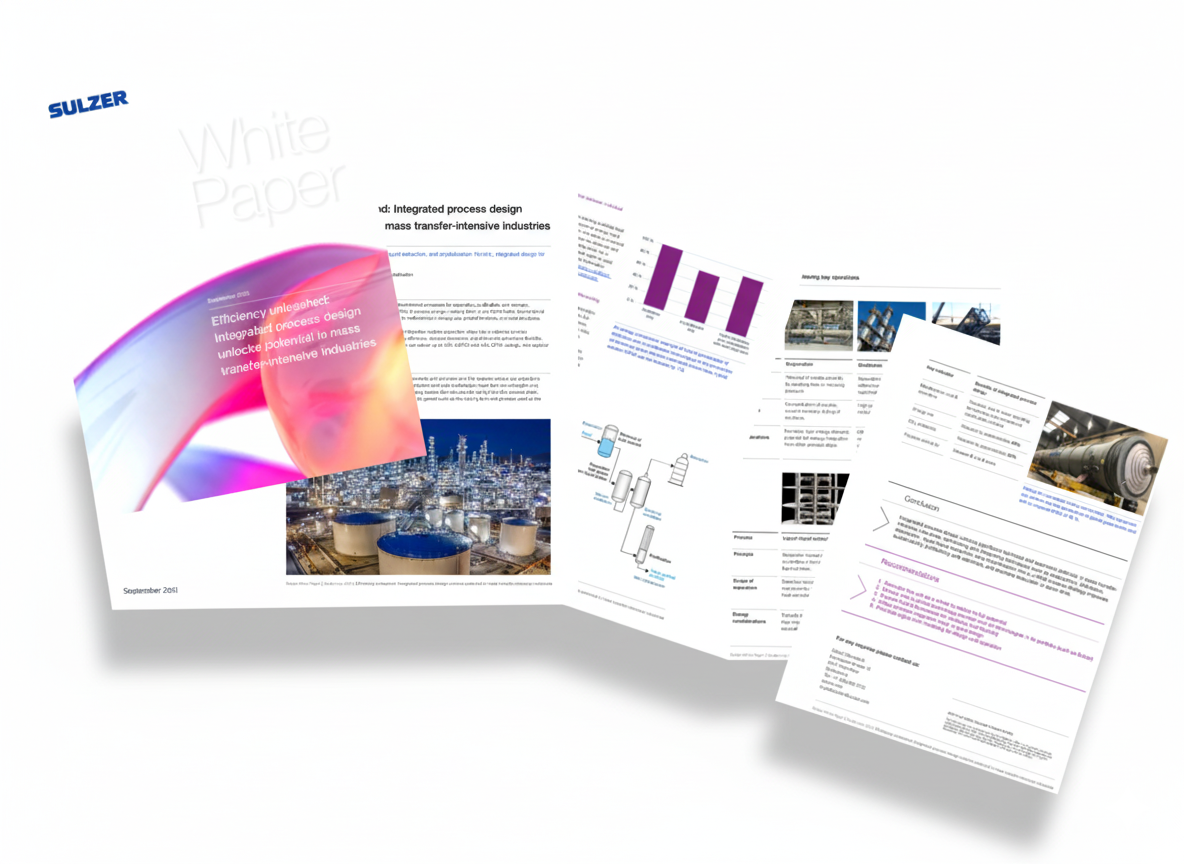
Download and discover how leading companies in mass transfer‑intensive industries are unlocking efficiency, sustainability and flexibility by:
- Integrating, e.g. evaporation, distillation, absorption, LLE and crystallization into an optimized process design.
- Achieving CAPEX reductions of up to 30% and OPEX savings of up to 40%.
- Cutting CO₂ emissions by up to 50% with energy‑efficient hybrid configurations.
- Leveraging on test centers capability and digital simulation to accelerate scale‑up and reduce risk.
- Improving operational flexibility to handle variable feedstocks and product specs.
- Shortening project timelines with fewer interfaces and simplified execution.
Sulzer upgrade conventional unoptimized systems with high-performance process that improved purity levels, significantly lower energy consumption, and enhanced flexibility.
With a complete portfolio of separation technologies and decades of experience, Sulzer is your ideal partner to design integrated processes that reduce costs, emissions, and risks. From test and simulation to start‑up, we deliver measurable results.
Looking to reduce OPEX or improve purification efficiency in chemical processing? Contact our team at crystallization@sulzer.com to discuss your application.
Unlock the full potential of your process unit
Integrated process design transforms complexity into opportunity. By combining techniques like evaporation, distillation, absorption, liquid-liquid extraction, and crystallization into a unified strategy, you can dramatically improve sustainability, profitability, and operational resilience. Reduce downtime, accelerate execution, and future-proof your operations.
Our recommendations for you:
- Think holistically: Treat the unit as a system, not just a sum of parts.
- Choose the right partner: Work with a technology provider that offers all key separation technologies.
- Design for flexibility: Explore hybrid flowsheets to boost reliability and adaptability.