Why solvent recovery is the untapped margin in API manufacturing
Solvents make up 60–90% of the mass moving through a typical API process and most of it still leaves as waste.
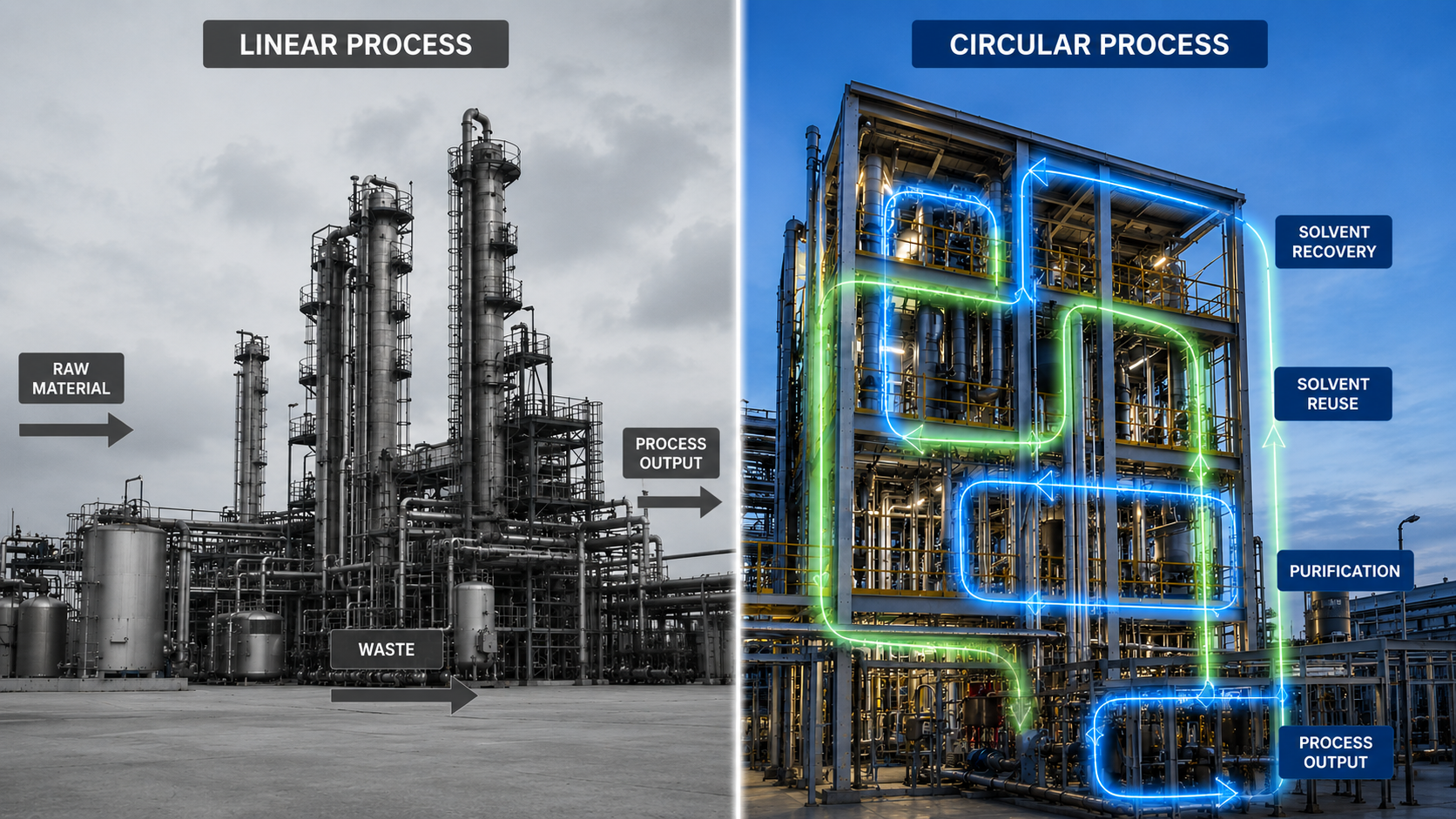
Active pharmaceutical ingredient production runs on solvents. They dissolve, extract, wash, and crystallize at nearly every step of a synthesis route. In a typical batch process they account for the large majority of total process mass. According to the ACS Green Chemistry Institute Pharmaceutical Roundtable, the solvent share of a manufacturing waste stream is around 60–70%. Under a conventional “take-make-dispose” model, that volume is procured once, used once, and then treated or incinerated as waste. The result shows up on three lines of the P&L at once: rising raw material procurement costs, growing waste treatment expenses, and mounting pressure from tightening emissions regulations. As sustainability requirements move from voluntary target to regulatory baseline, that linear model is becoming a structural cost problem rather than a manageable one.
The economics were always there, the technology is catching up
What makes this moment different is not that solvent recovery is a new idea. What has changed is the technical difficulty of the mixtures manufacturers now need to recover from. Modern API routes increasingly rely on multi-solvent systems, azeotropic mixtures, and heat-sensitive intermediates that degrade under the thermal conditions of standard distillation. Recovering a single solvent from a clean binary mixture is straightforward; recovering high-purity solvent from a complex, multi-component stream without damaging a sensitive API precursor is a genuinely harder separation problem, and it is this gap, not the economic case, that has kept many plants from closing the loop.
Two mechanisms explain why circularity changes plant economics rather than simply improving optics. First, solvent procurement and disposal are both volatile cost lines: recovery converts a variable, market-exposed cost into a largely fixed, on-site process cost, which is a real resilience gain against supply disruption. Second, energy is usually the binding constraint on recovery economics, not capital. A recovery system that runs at high reboiler duty can erase the savings it was built to capture. This is why energy intensity, not just recovery yield, is the metric that determines whether a circular solvent strategy actually pays back.
Closing the loop requires more than a still
A single distillation column can recover a simple solvent from a simple stream. Closing the loop on real plant conditions requires several separation and treatment technologies working as a system rather than in isolation. Sulzer combines high-performance distillation and solvent recovery technologies such as DistilCare™ and EXCELOT™, which are designed to recover high-purity solvents from complex, multi-component and heat-sensitive mixtures without degrading the product. Where distillation reaches its practical limits particularly with azeotropes and other systems that resist conventional separation Sulzer's OptimEXT™ liquid-liquid extraction technology recovers solvent beyond those limits while consuming less energy than pushing distillation further. Downstream, PEMFlux™-W addresses the VOC load and organic content in the resulting process water waste stream, which matters because a recovery process that solves the solvent problem but creates a discharge compliance problem has only moved the liability, not removed it. VoltaSplit™ extends the same logic to the plant's energy balance, applying electrified distillation to cut steam demand and the associated CO2 footprint relevant as more sites plan for electrification rather than continued reliance on steam-raising boilers.
What the combination delivers in practice
Integrated correctly, these technologies are reported to recover up to 99% of valuable solvents while cutting energy consumption by as much as 50% compared with conventional recovery approaches. The right combination of technologies directly targets the two variables that determine whether circular operation pays for itself: recovery yield and the energy cost of achieving it. The compliance and OPEX benefits follow from getting that combination right, not from any single unit operation working harder.
For a plant currently treating solvent as a single-use input, the practical question is not whether recovery is worth pursuing, but which part of the process, the mixture complexity, the energy balance, or the wastewater discharge, is actually limiting how much value can be recovered today. That is usually where the case for a circular retrofit is won or lost.
Have Questions or Need More Information?
We're here to help! Whether you have questions about our solutions or want to discuss how we can support your specific needs, feel free to reach out.