Return-on-Plastics: Why the economics of value recycling come down to what happens downstream
Everybody knows ROI. But in chemical recycling, the metric that actually determines whether a project gets built – or gets shelved – is something different. Call it Return-on-Plastics: the ability to extract maximum value from a contaminated, variable, hard-to-recycle feedstock, and turn it into a product that commands a real market price. It sounds simple. In practice, it is where most projects break down.
Defining the business model for polyolefin recycling
The chemical recycling industry has made significant progress. Pyrolysis processes are maturing. Legislative frameworks are (finally) being created. Capacity is being built. Investors are paying attention.
Critical in defining the business model is defining the target product specification based upon feedstock input specifications, utility availability, capacity, capital to be allocated, and many more.
Raw pyrolysis oil is not a finished product. It is a starting point – one that typically carries chlorine, nitrogen, silicon, metals, and other contaminants that must be removed before the oil can be blended into cracker feedstock at meaningful rates. The yield loss, the purification cost, and the CAPEX required to bridge that gap are where Return-on-Plastics is either captured or destroyed.
This is the economics problem that the industry has underestimated. And it is the problem that defines whether a project at 25, 50, or 100 kt/a is viable – or marginal. Even more so in today's chemical and waste markets that face significant headwinds.
Where value is lost (and where it is preserved)
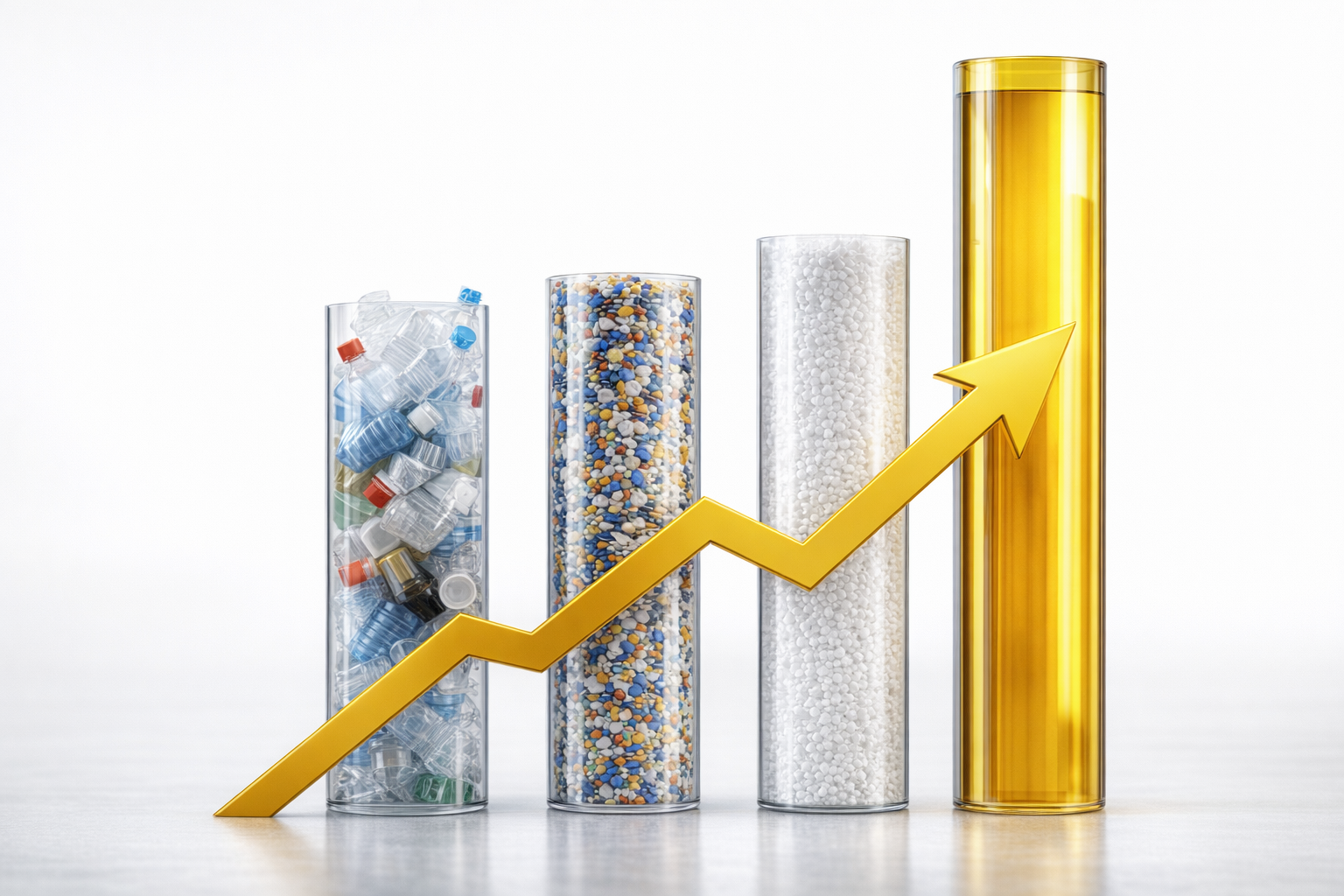
Think of the value chain as four stages, each one a decision point.
Stage 1: Raw plastic waste. Variable in composition, contaminated, often mixed. The feedstock economics depend on collection costs and tipping fees – but the real value is latent. It has not been unlocked yet.
Stage 2: Sorting and preparation. Mechanical processing and sorting creates a feed suitable for pyrolysis processes. Value is preserved here, not created. The goal is extracting those fractions that can be valorized.
Stage 3: Pyrolysis and condensation. This is where the chemistry happens – and where fouling, repolymerization, and yield loss are the primary risks. A poorly designed conversion process can reduce liquid oil recovery significantly. The condensation system, often prone to fouling and blockages, can create significant downtime. At commercial scale, that is not a rounding error. That is millions of euros in lost margin per year.
Stage 4: Purification and upgrading. This is where money will ultimately be won or lost. Can you remove contaminants efficiently enough to meet cracker specifications? Can you do it at a CAPEX and OPEX that makes the project viable? Can you scale the solution reliably as capacity grows?
Most project economics fail not at Stage 1 or 2 – but at Stages 3 and 4, where the engineering complexity is highest and the wrong technology choices are most costly.
The numbers that change the conversation
Advanced hydrotreating – the key upgrading step that converts purified pyrolysis oil into cracker-ready feedstock – has requires expensive high-pressure equipment, and complex reactor configurations. For many projects, the CAPEX alone has been the deciding factor against proceeding.
Sulzer's MaxFluxTM technology was engineered specifically to address this. By using a liquid-full reactor design, MaxFluxTM achieves:
- 30–40% lower CAPEX versus traditional hydrotreating configurations
- 20–30% lower OPEX, driven by replacing compressors with pumps and reducing utility consumption
- 10–15% lower carbon footprint, as a result of reduced hydrogen requirement and lower energy intensity
For a project at 50 kt/a capacity, that CAPEX differential alone can represent 5-10% in IRR or more – the difference between a project that passes board approval and one that does not.
These are not projections. MaxFluxTM has been awarded, and engineered. The reference exists. The numbers have been validated.
The downstream is an enabler
In a market where reactor technology capacity is projected to come online, the downstream is where competitive differentiation is built.
The recyclers who will lead this industry through 2030 are not necessarily those with the best reactor. They are the ones who have engineered the full pathway based upon their specific requirements – from variable feedstock to consistent, specification-compliant output – at economics that hold up under real operating conditions in changing environment.
That requires:
- Fouling-resistant condensation that maintains uptime and protects liquid yield from the first stage
- Flexible purification strategies that adapt to feedstock variability across chlorine, nitrogen, silicon, and metal contaminants
- Advanced upgrading that reaches cracker-ready quality at a CAPEX the project can actually support
This is what Sulzer's integrated portfolio for polyolefin recycling – PyroCon™, PyroCare™, and MaxFluxTM – is designed to deliver. Not as standalone technologies, but as a connected pathway from waste input to market-ready output.
Finding your pathway
Every project is different. Feedstock composition, target output quality, capacity, and regional market dynamics all shape the right technology configuration.
That is why we built the waste-to-value product navigator – a tool that takes your feedstock type and processing objectives as inputs and maps you to the Sulzer technology pathway best suited to your scenario.
It is the fastest way to move from "we have a feedstock" to "we have a technology strategy"– without the guesswork.
Have Questions or Need More Information?
We're here to help! Whether you have questions about our solutions or want to discuss how we can support your specific needs, feel free to reach out.
_compressed.png?width=352&name=0109-MCTS_Aftermarket_Campaign_2560x14402%20(1)_compressed.png)