The purity premium: Same molecule, different market
Phosphoric acid sold for fertilizer and phosphoric acid sold to a semiconductor fab are the same compound. What separates a commodity price from a specialty one is how far the impurities have been driven down; and increasingly, how far they need to go
Electronic-grade chemicals are among the fastest-growing segments in specialty chemicals, underpinning semiconductor fabrication, battery production, and advanced electronics manufacturing. What defines the category isn't new chemistry; most of these molecules are well known and produced at industrial scale for entirely different, far less demanding markets. What defines it is the standard: trace metal impurities controlled to parts-per-billion levels, analytical protocols that can prove it batch after batch, and supply consistency that a fertilizer or cleaning-product buyer would never require. As electrification of transport, data center expansion for AI workloads, semiconductor capacity growth, and photovoltaic manufacturing all scale up in parallel, tolerance for contamination keeps tightening; a trace metal that's negligible in a conventional industrial process can degrade a battery cell or cut yield in an IC fab.
The purity gap is usually smaller than it looks
For companies already producing the industrial-grade version of these molecules, the jump to electronic grade is less a leap into new territory than a further push along a purification curve they're already on. The gap is typically defined by a small number of blocking impurities; one or two trace metals, a single ionic species, a residual organic carried over from an upstream step; rather than a broad, diffuse contamination problem. Once those specific blockers are mapped back to where they enter the process (feedstock, equipment contact, handling, storage), a targeted purification strategy can close the gap without sacrificing yield or reworking the whole process. This is why the more useful question for an established producer usually isn't "Can we make electronic-grade chemicals?", but "Which of our existing product streams has a purity gap that's actually economically attractive to close?"
Why crystallization is a powerful tool for this exact problem
Distillation, adsorption, and ion exchange remain effective separation methods within their own domains, but they reach a ceiling against the impurity profiles most electronic applications are sensitive to; they can get a stream clean, but not clean enough, or not without introducing new contamination sources like solvents or resin bleed. Melt crystallization is positioned as the technology that operates where traditional separation methods reach their limits. It is able to separate isomers and heat-sensitive products with a minimum energy consumption. Melt crystallization also enables precise impurity segregation that ppb-level specifications demand. Its high selectivity is due to the separation mechanism: Rather than trying to strip out every contaminant class at once, fractional crystallization exploits the freezing-point difference between the target molecule and its impurities. This excludes trace contaminants as the pure phase forms. That's also why it works as a final polishing step rather than a replacement for upstream separation.
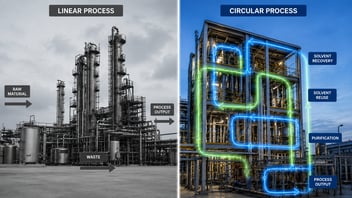
Three crystallization configurations cover different parts of this problem: Suspension crystallization for a compact layout with high separation efficiency even from low feedstock concentrations, static crystallization using a heat exchanger plate bundle for high purity with versatile, fully automated operation, and falling film crystallization for the highest-throughput, highest-purity applications. The right configuration depends on feedstock concentration, throughput, and how far below the industrial-grade baseline the impurity ceiling needs to sit. The process itself is also solvent-free and runs on electricity with no waste byproduct, which matters for producers who don't want to trade a purity problem for a new effluent-treatment one.
Proven at the scale the semiconductor industry actually demands
This isn't an emerging or unproven approach. Sulzer has developed and deployed melt crystallization technologies for over 40 years, with installations across every major chemical-producing region, and has demonstrated parts-per-billion impurity control across various critical ions in electronic-grade applications; the kind of multi-ion, multi-decade track record that qualification teams in semiconductor and battery supply chains actually check for. That track record extends from individual crystallizers integrated into an existing plant, through full technology licensing, to complete greenfield purification trains; meaning a producer testing the economics of one product line doesn't need to commit to a full plant redesign to find out if the purity gap is closable.
Closing the gap is a systems problem, not just a chemistry one
Purification capability means nothing if it doesn't survive contact with the rest of the production system. Customers in semiconductors and battery manufacturing don't just verify a batch against a spec; they qualify the entire supply chain behind it, from raw material sourcing through packaging and delivery. A single contact material or packaging choice can easily reintroduce the exact trace contaminant the crystallization step just removed. Producers who treat qualification requirements, materials of construction, handling, and analytical methods as design inputs from the start close that gap faster than those who treat it as a late-stage check. For established chemical producers, the opportunity is rarely limited by chemistry. It's defined by how deliberately the purification step, and everything around it, is engineered to preserve that purity until commercialization
Have Questions or Need More Information?
We're here to help! Whether you have questions about our solutions or want to discuss how we can support your specific needs, feel free to reach out.