Closing the loop on EPS: why expanded polystyrene deserves a circular future
A material paradox: excellent performance, poor recycling outcomes
Expanded polystyrene is one of the most versatile materials in modern industry. It insulates buildings, protects fragile electronics during shipping, and keeps food fresh across global cold chains. Global production exceeds 10 million metric tons per year, with packaging accounting for roughly 70% of total use and building insulation making up most of the remainder.
Yet despite its functional value, EPS has one of the lowest recycling rates of any commodity plastic. In the United States, the recycling rate for EPS sits at approximately 15%. In Europe, packaging EPS recycling has reached roughly 46%, but construction-grade EPS — often contaminated with flame retardants — remains largely excluded from recycling streams. Millions of cubic metres of EPS end up in landfills or incinerators every year, representing a massive loss of embodied material value and a growing environmental burden.
Why EPS recycling has lagged behind
The challenges are both logistical and technical. EPS is 95–98% air by volume, making it expensive to transport relative to its material weight. Collection infrastructure remains patchy, particularly for post-consumer packaging and demolition waste. But the most significant barrier is contamination. Post-consumer EPS is typically mixed with food residues, adhesives, labels, and other materials. Construction-grade EPS may contain flame retardants such as HBCD or its replacement PolyFR, both of which are difficult to remove through conventional methods.
Mechanical recycling can process clean, sorted EPS by grinding and re-moulding it, but this approach delivers a downcycled product with limited applications and cannot handle contaminated streams. Traditional chemical recycling methods — including pyrolysis and dissolution — often struggle with the purity levels required for food-contact or ASTM-grade styrene, particularly when closely boiling impurities such as o-xylene and phenylacetylene are present in the depolymerised mixture.
Chemical recycling changes the equation
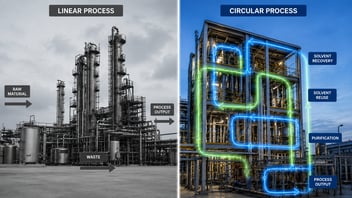
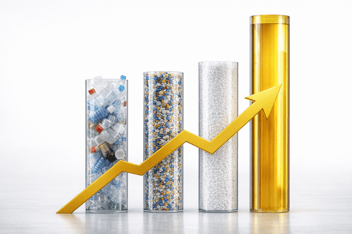
Advanced chemical recycling technologies now make it possible to depolymerise EPS waste back into its original monomer, styrene, at purity levels suitable for re-polymerisation into new, virgin-quality polystyrene. This is the fundamental shift that EPS needs: not downcycling into lower-value products, but true closed-loop recycling that recovers the full material value.
Sulzer Chemtech’s EcoStyrene™ technology is designed precisely for this purpose. The process combines advanced depolymerisation with proprietary extractive distillation and hybrid separation to produce ASTM-grade styrene monomer — even from heavily contaminated EPS feedstocks containing flame retardants and food residues. The resulting monomer is indistinguishable from virgin styrene and can be used directly in food-contact packaging, medical applications, and high-performance engineering plastics.
From waste to value: the economics of EPS circularity
The business case for EPS chemical recycling is strengthening rapidly. Regulatory pressure is intensifying across all major markets. The EU’s Packaging and Packaging Waste Regulation (PPWR), which entered into force in February 2025, mandates minimum recycled content thresholds for plastic packaging from 2030, with targets ranging from 30% to 65% depending on the packaging category. Similar frameworks are emerging in the United States, where states including California, Oregon, and Colorado have enacted extended producer responsibility legislation with recycled-content targets and eco-modulated fees.
For brand owners, converters, and polymer producers, access to a reliable supply of food-grade recycled styrene is becoming a competitive necessity rather than a sustainability aspiration. EcoStyrene™ delivers this by accepting the broadest possible range of EPS feedstocks — including construction and demolition waste that other technologies reject — and converting them into high-value monomer at attractive capital intensity.
EPS deserves better than landfill
EPS is too valuable and too functional to discard. Its thermal insulation properties are critical for meeting building energy efficiency targets, and no alternative packaging material matches its combination of impact protection, weight, and cost-effectiveness. The answer is not to ban EPS but to build the recycling infrastructure and technology base that can close the loop on this material at industrial scale.
EcoStyrene™ represents a proven pathway to achieve this. With unit operations validated at commercial scale, a scalable licensed technology model, and the ability to process even the most challenging EPS waste streams, it enables the transition from a linear use-and-dispose model to genuine EPS circularity.
Have Questions or Need More Information?
We're here to help! Whether you have questions about our solutions or want to discuss how we can support your specific needs, feel free to reach out.